
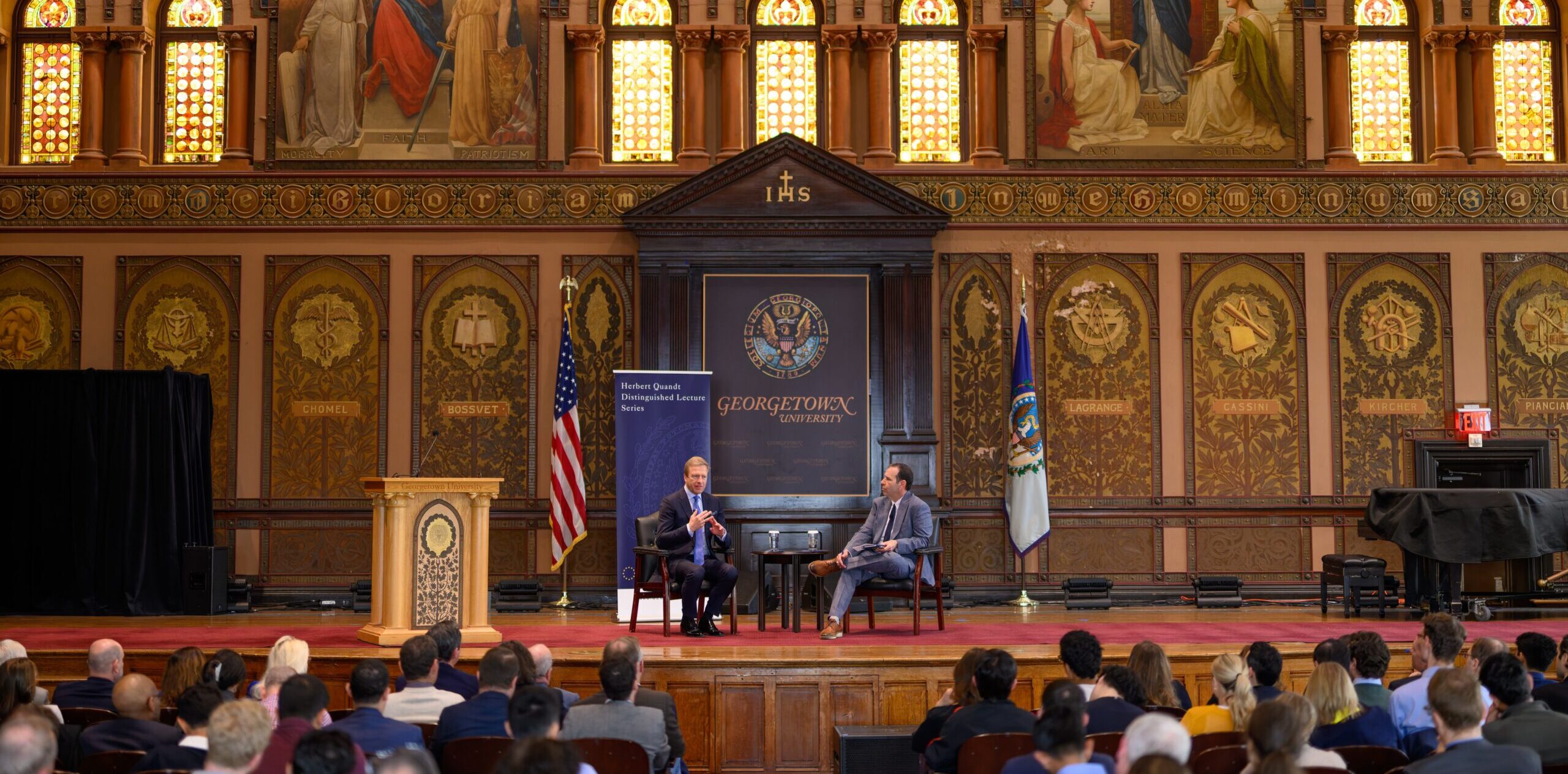
Chairman of the Board of BMW Oliver Zipse: Strategic Challenges for theGlobal Auto Industry
On Monday, March 23, the BMW Center was honored to host Oliver Zipse, Chairman of the Board of Management of BMW in the 8th Herbert Quandt Distinguished Lecture. The event was opened by Joel Hellman, dean of the School of Foreign Service, who welcomed ambassadors, students, faculty, and distinguished guests. He highlighted BMW’s longstanding role not only as one of the world’s leading automotive manufacturers, but as a key supporter of Georgetown’s BMW Center for German and European Studies.
“We come together, of course, at a moment of profound change in the global order,” Hellman said. “It’s a change that’s causing tremendous uncertainty, tremendous risk, and hopefully some new opportunities. But one of the things we have learned at this moment of tremendous change is how critical the role of the private sector is in shaping wherever the global order goes from here.”
Zipse, who joined BMW in 1991 and became Chairman of the Board of Management in 2019, has been central to the company’s global expansion, particularly in the United States. The Spartanburg, South Carolina plant now employs 11,000 people directly, supports tens of thousands of additional jobs across the state, and anchors a value chain that extends throughout the U.S. economy.
“BMW calls the United States our second home,” Zipse said. “BMW is made in America and sold to the world.”
For Zipse, Spartanburg is “a perfect example of successful foreign direct investment and the economic benefits of open markets and free trade.”
Quoting President Bill Clinton’s 1999 Quandt Lecture at Georgetown, Zipse recalled the
expectation that a new generation would “compete in a global marketplace” and “share ideas and experiences with people from every culture.” For BMW, that period was one of rapid internationalization: expanding production in the United States, building a major joint venture in China, and evolving into a global player with products sold in over 140 countries. “Today, a BMW manufactured in Germany is inconceivable without U.S. technology companies,” he noted.
Yet the landscape today, Zipse said, is dramatically different. A series of shocks—from the global financial crisis of 2008–2009 to Brexit, the rise of extremist parties, the COVID-19 pandemic, the invasion of Ukraine, and conflict in the Middle East—has shaken the foundations of the earlier order.
“These geopolitical crises, several of which have occurred in parallel, have been destabilizing politically and economically and led to a dissolution of global collaboration,” he said.
Rapid advances in artificial intelligence, technological decoupling between regions, and
divergent regulatory frameworks—especially in Europe—have added new burdens for
automotive manufacturers.
“The lack of a realistic and long term, coherent industrial framework has weakened European OEMs’ competitive position on the world stage,” he said. “Customer demands and innovation should drive policy, as they have done successfully for decades.”
Zipse made four key points regarding a path forward in his remarks. First, complexity should be viewed as an opportunity, not a burden.
“From a management perspective, all these geopolitical conflicts are about one overarching question: how do you become anti-fragile as a company?” he asked. The answer, he argued, lies in a “stable and broad base and successful business model and strategy globally, multi segmented and technology open.”
His second point is that protectionism does not promote economic growth.
“We should not fear competition, but welcome it,” he said. “The best ideas and innovations are born on a global marketplace, and we know that in the long run, trade restrictions always result in a backlash where ultimately no one wins.”
His third and final point is that companies must stay grounded in facts and analysis rather than short-lived trends or external hype.
“Facts, analysis, and a holistic view of current developments should always form the basis for managerial decisions,” he said, “rather than allowing policy or an exaggerated hive of capital markets to dictate strategy.”